But the iTunes Store will likely see less of me at 3 a.m., thanks to Bit of Paradise’s SonicMood, an ambient-sound generator. Playing a combination of moody synthesized instruments and digitized nature sounds, the highly configurable SonicMood generates the kind of.
Removals on Mac OS X are quite different from those on Microsoft Windows OS. This page can help you understand the basic knowledge of system maintenance, guiding you through the confusion of removal problems. If you happen to be a newbie of Mac Computer, take the chance to learn something. Now go with how to correctly remove SonicMood 5.2.
Removing the useless applications from your computer is still one of the simplest ways to speed up your system, where everything lives to work, occupying part of the hardware resources including hard drive space and memory. So there is one thing you can be sure of: too many junks will slow down your computer, and they are accumulating during the operation. If you don’t deal with them termly, issues would be generated.
Let’s temporarily isolate other Windows logicality from our mind, forget about the Start menu, Control Panel, Registry Editor, etc. Regards to removals on Mac OS X, keywords shall be Finder, Library, Preference, and Application Support instead. The following are specific steps for you to fully remove SonicMood 5.2. I believe after going through the whole process, you will be much more familiar with your Mac.
Using Osx Uninstaller to Breezily Remove SonicMood 5.2
In the very beginning, I would like to introduce an easy approach to uninstall this app on Mac, just in case you are like “Geez, don’t put me through the knowledge. What I’m only interested in is how to quickly get things done”. There you go:
1.Download - Install - Run Osx Uninstaller
2.Select - Run Analysis
In the list of installed applications, select SonicMood 5.2 as a target, and hit “Run Analysis”. Download ifr flight trainer simulator for mac pc.
3. Complete Uninstall
It displays the files to be removed with their names, sizes and locations behind. Click on “Complete Uninstall” to proceed with the removal. If you are prompted with the confirmation, click on “Yes”.
Seeing it states “Congratulations! SonicMood 5.2 has been successfully removed..” means you have achieved your goal. You can click “Back to Interface” to reach the list of installed application and check whether the program has gone.
OK, it’s time to present you with the instruction of manual uninstall, which will also work to remove SonicMood 5.2. Just consider this as a free tour on your system.
Manual Steps to Remove Apps on Mac
4. Empty the Trash
Do it once you are certain that you will never use SonicMood 5.2 again (or in a short time at least). Right-click on the Trash icon, select “Empty Trash”. It will ask for your confirmation, also click “Empty Trash” on the message. This will permanently remove SonicMood 5.2 and everything inside, freeing up the hard drive space on your Mac.
5. Finder - Go - Library
In the entire removal process, the Library folder could be a blind spot to many users. So this is teaching you how to delete the Support and Preference Files from it, which are those left behind after you remove SonicMood 5.2 application. Usually they are very small, so if you attempt to reinstall the application, you can keep them. Otherwise, just do the following to clean them out.
In the upper-left corner of the screen, hold the “Option” key on your keyboard, click “Go” on the Finder, and select “Library” to open the Library folder. To ensure the complete removal, it would be better to unhide the Library folder permanently.
6.Unhide the User Library folder
Open Finder and navigate into your home folder, then successively click Macintosh HD - Users - Username.
Click “View” in the menubar, and select “Show View Options” or press “J” on your keyboard. On the new window, tick the box before “Show Library Folder”.
Open Finder, and navigate to Applications - Utilities - Terminal (double-click to launch).
Type “chflags nohidden ~/Library” into Terminal (without the quotation marks), and press “Return” on your keyboard to run the command.
To improve search results for Linde Pathfinder try to exclude using words such as: serial, code, keygen, hacked, patch, warez, etc. Simplifying your search query should return more download results. Many downloads like Linde Pathfinder may also include a crack, serial number, unlock code or keygen (key generator). Linde Pathfinder Keygen Generator; Linde Pathfinder Keygen Generator Software; Our portfolio consists of three different types of oxygen generator (V)PSA plants as following:. VPSA: Our customised oxygen VPSA plants range in capacity from around 300 Nm³/h up to 10,000 Nm³/h and can produce oxygen purities between 90 and 95 percent per volume. It means a small program that can generate an activation code, serial number, license code or registration number for a piece of software. A keygen is made available by crack groups free to download. If you search a site for Linde Pathfinder Keygen, you may see the word 'keygen' in the results which usually means your download includes a keygen. Linde pathfinder keygen for mac pro. Linde Truck Doctor v2.01.05 GERMAN/ENGLISH is the diagnosis software for Linde warehouse equipment. 2014 years newest version Linde Pathfinder v3.5.8.2+ Linde Truck Doctor v2.00.18 EN +linde Keygen. Linde keygen. Linde Pathfinder v3.5.8.4 is the diagnostic software for Linde forklift trucks and warehouse equipment. It contains service bases up.
How to re-enable the feature? Run the “chflags hidden ~/Library” command in Terminal.
7.Browse - Trash
Under ~/Library/, ~/Library/Preferences/, and ~Library/Application Support/, look for the files or folders with SonicMood 5.2’s name or its developer’s name.
Then right-click on it, select “Move to Trash” to delete it. If you can’t “Empty Trash” right away, restart your Mac and try again. This is how you can manually remove SonicMood 5.2 on your Mac.
Uninstall guides of related apps
Categories
- 1
- Browsers74321 apps in database
- 2
- Business Software62976 apps in database
- 3
- Communications99466 apps in database
- 4
- Desktop Enhancements74314 apps in database
- 5
- Developer Tools98514 apps in database
- 6
- Digital Photo Software46410 apps in database
- 7
- Drivers31491 apps in database
- 8
- Educational Software40086 apps in database
- 9
- Entertainment Software85593 apps in database
- 10
- Games96171 apps in database
Completely removes:
- Bundled apps
- Preferences files
- Cache files
- Support files
- Other hidden file
Call me weird – and no doubt you will – but I often like to have my computer make random noise. The reason is that when I’m working at my computer on a piece of writing, I don’t like silence. To stay focused, and to help drown out the distracting natural and artificial noises of the neighborhood, it helps me to have some steady sound proceeding in the background. That sound, however, must not involve human voices, such as radio or television. If Terry Gross or the Car Talk guys are on, no work will get done; instead, I’ll listen to them. The same thing applies to music. Unlike many people, I can’t tune music out; music as background doesn’t work for me. Perhaps this is because of my classical training – I don’t know – but whatever the reason, when music is in the air, I tend to listen. This phenomenon is especially troublesome, by the way, in drug stores and restaurants that use Muzak or 'Easy Listening' or other pseudo-musical perversions; I can’t stop listening, and what I’m hearing is horrible, so I typically run screaming from the place moments after entering. How people can actually work in such venues, or what restrains them from suing their employers, has always been a mystery to me. Everyone complains of the ghastly holiday music that pervades workplaces in the run-up to Christmas, but to me, the whole world sounds like that all year round. But I digress.
<http://www.npr.org/programs/fa/>
<http://www.cartalk.com/>
As I said at the outset, while working at my computer, I often want sound, but not speech, and not music either; and the solution is random noise. I’m referring here to sound that goes nowhere and has no discernible pattern, sound that is gentle and pretty and unobtrusive. Such sound has nothing to grab the mind’s attention, nothing to remind the hearer of the passage of time; yet neither is it soporific or monotonous. This sort of sound, I find, helps to keep my mind alert and relaxed; it pleases me and warms the atmosphere, yet it leaves me free to focus on the task at hand.
There are a surprisingly large number of good random noise generators for Mac OS X. Yet most of them do not quite fit my needs. Jon Klein’s Musik makes random notes, but uses just one instrument, and patterns rapidly start to emerge, so that it quickly becomes boring and annoying at the same time. (Klein is best known for his remarkable cross-platform Breve artificial-life simulation environment.) Composer Karlheinz Essl is single-handedly responsible for several interesting real-time music-generation applications. His FontanaMixer is an attempt to recreate a famous aleatory John Cage piece; it’s remarkable, but it grabs most of your CPU, making it hard to get anything else done, and its sounds are raspy and clanky, involve a human voice, and are mixed with long periods of silence, as if someone were muttering while sorting through the garbage cans in an alley – not exactly conducive to great expository writing. His Seelewaschen is also quite CPU-heavy, visibly slowing down my typing rate; it involves a tolling bell reprocessed to give various raspy, chirpy effects – sobering, but not relaxing. Much more to my taste is Essl’s now classic LexikonSonate, which plays a random but extremely musical and sophisticated piano; it stops and starts rather a lot, though, and the piano sound is rather percussive. Besides, the very qualities that make its output musically brilliant and intriguing militate against its use as subconscious background – it makes me want to listen.
<http://www.spiderland.org/musik/>
<http://www.spiderland.org/breve/>
<http://www.essl.at/works/fontana-mixer/ download.html>
<http://en.wikipedia.org/wiki/John_Cage>
<http://www.essl.at/works/seelewaschen/ download.html>
<http://www.essl.at/works/Lexikon-Sonate.html>
Make the Mood — By this point you’re probably thinking to yourself: 'I see what this fellow is after. He wants something more along the lines of Music From the Hearts of Space – hippy-dippy, mellow, environmental earwash. He wants ambient music.' You’re right; I do. That isn’t at all the kind of music I like to listen to, but it’s the kind of music I want playing when I don’t want to listen. And that’s why my favorite background random noise program is presently SonicMood, from Bit of Paradise Products.
<http://www.hos.com/aboutmusicright.html>
<http://homepage.mac.com/johnrhall/ BitofParadiseProducts.htm>
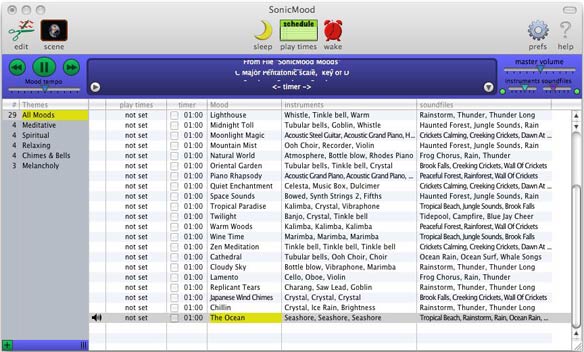
SonicMood has all the right elements for me. It uses pleasant QuickTime instrument sounds, combined into small, gentle ensembles (no more than three different kinds of instruments), playing long tones in a variety of modes (scales), sometimes sounding rather like a cross between foghorns in a harbor and Palestrina on drugs. Each combination of parameters – number and choice of instruments, maximum polyphony, average duration and pause, amplitude range, and mode – is called a Mood, and you can edit existing Moods and create new ones. Not only is each Mood random, within its parameters, but SonicMood also cycles through its Moods, randomly or sequentially, at time intervals that you define. Thus SonicMood provides an ever-changing kaleidoscope of unobtrusive sound environments – and if you do find any of the moods objectionable, you can simply eliminate it. (SonicMood can also display images, but this isn’t a feature I use; in fact, I usually hide SonicMood completely right after starting it up.)
<http://en.wikipedia.org/wiki/Giovanni_Pierluigi _da_Palestrina>
SonicMood might not be everyone’s cup of tea, but surely I can’t be the only person in the world who occasionally wants this sort of sound to emanate from the computer, and in any case it has certainly been helpful to me in my work, and therefore, quite directly, to TidBITS. So, in the class of Tools We Use, I recommend it to your attention. The developer, John R. Hall, is very responsive to suggestions; he quickly added a Dock menu at my request, so that I could pause and start SonicMood without making it visible. SonicMood is just $10, with a 30-day free demo trial period, and is available for both Mac OS X and Mac OS 9; version 2.0 is available now, and version 3.0 should be released shortly.
<http://homepage.mac.com/johnrhall/ SonicMoodPage.htm>