R is an incredibly powerful open source program for statistics and graphics. It can run on pretty much any computer and has a very active and friendly support community online. Graphics created by R are extremely extensible and are used in high level publications like the New York Times (as explained by this former NYT infographic designer).
RStudio is an integrated development environment (IDE) for R. It’s basically a nice front-end for R, giving you a console, a scripting window, a graphics window, and an R workspace, among other options.
To do this, we'll spend a bit of time using R as a simple calculator, since that's the. Of doing that you should now install RStudio (see Section 3.1.4 for instructions). Windows and Mac users for their fancy GUIs, you can download RStudio too. RStudio is an integrated development environment (IDE) for R. It includes a console, syntax-highlighting editor that supports direct code execution, as well as tools for plotting, history, debugging and workspace management.
R Commander is a basic graphical user interface (GUI) for R. It provides a series of menus that allow you to run lots of statistic tests and create graphics without typing a line of code. More advanced features of R aren’t accessible through R Commander, but you can use it for the majority of your statistics. (Lots of people (like me) use R Commander as a crutch for a few months before they get the hang of the R language. As intimidating as it might be to constantly type stuff at the console, it really is a lot faster.)
However, as is the case with lots of free and open source software, it can be a little tricky to install all of these different programs and get them to work nicely together. The simple instructions below explain how to get everything working right.
Install R, RStudio, and R Commander in Windows
- Download R from http://cran.us.r-project.org/ (click on “Download R for Windows” > “base” > “Download R 2.x.x for Windows”)
- Install R. Leave all default settings in the installation options.
- Download RStudio from http://rstudio.org/download/desktop and install it. Leave all default settings in the installation options.
- Open RStudio.
- Go to the “Packages” tab and click on “Install Packages”. The first time you’ll do this you’ll be prompted to choose a CRAN mirror. R will download all necessary files from the server you select here. Choose the location closest to you (probably “USA CA 1” or “USA CA 2”, which are housed at UC Berkeley and UCLA, respectively).
- Start typing “Rcmdr” until you see it appear in a list. Select the first option (or finish typing Rcmdr), ensure that “Install dependencies” is checked, and click “Install”.
- Wait while all the parts of the R Commander package are installed.
- If you get permission errors while installing packages, close R Studio and reopen it with administrator privileges.
Install R, RStudio, and R Commander in Mac OS X
- Download R from http://cran.us.r-project.org/ (click on “Download R for Mac OS X” > “R-2.x.x.pkg (latest version)”)
- Install R.
- Download RStudio from http://rstudio.org/download/desktop.
- Install RStudio by dragging the application icon to your Applications folder.
- Download Tcl/Tk from http://cran.r-project.org/bin/macosx/tools/ (click on
tcltk-8.x.x-x11.dmg; OS X needs this to run R Commander.) - Install Tcl/Tk.
- Go to your Applications folder and find a folder named Utilities. Verify that you have a program named “X11” there. If not, go to http://xquartz.macosforge.org/ and download and install the latest version of XQuartz.
- Open RStudio.
- Go to the “Packages” tab and click on “Install Packages”. The first time you’ll do this you’ll be prompted to choose a CRAN mirror. R will download all necessary files from the server you select here. Choose the location closest to you (probably “USA CA 1” or “USA CA 2”, which are housed at UC Berkeley and UCLA, respectively).
- Start typing “Rcmdr” until you see it appear in a list. Select the first option (or finish typing Rcmdr), ensure that “Install dependencies” is checked, and click “Install”.
- Wait while all the parts of the R Commander package are installed.
Open R Commander in Windows and OS X
Once you’ve installed R Commander, you won’t have to go through all those steps again! Running R Commander from this point on is simple—follow the instructions below.
If you decide to stop using R Commander and just stick with R, all you ever need to do is open RStudio—even simpler!
- Open R Studio
- In the console, type
windows()if using Windows,quartz()if using Mac OS X. (This tells R Commander to output all graphs to a new window). If you don’t do this, R Commander graphs will be output to the graphics window in RStudio. - Go to the “Packages” tab, scroll down to “Rcmdr,” and check the box to load the plugin. (Alternatively, type
library(Rcmdr)at the console.)
I have fallen in love with the R language and tool set over the last few weeks. I find that getting outside my comfort zone and learning new tools can always spur creativity and the open source community has a great many tools just waiting to be discovered. The fact that there is a free option for RStudio provides a powerful analysis tool to organizations without taking a large hit to the budget.
R is a statistical computing and graphics language and is available as free software under the GNU general public license. RStudio is a free and open source integrated development environment that puts a user interface over the R command line back end. The combination of the two provides a powerful data analysis toolset.
The tools are more command line and have a programming style rather than a point and click tool such as Microsoft’s Excel. This tool would appeal to the power user analyst or a user with more of a programming background.
R has a Very Active Community
The trouble with adding open source software to your workflow is making sure that the tool is active and being updated on a regular basis. The main criteria I look for is based on how large and active the community around the tool is.
- Do people have a passion for the software?
- Is there an active community?
- When was the last update?
- How often has the software been updated?
R has a large active community and provides functions and extensions to the tool set through external libraries which can be imported as you need and discover them.
Installing R & RStudio on a Mac
The installation on a Mac is simple and straight forward. There are 2 installations that are required, the R language and the RStudio front end. You can install a desktop or server version, however I find for personal use the desktop install and user experience easier to manage.
but try the.Dunlavy 10086.5' Mid-BassDunlavy 10121' Dome Tweeter D27TG35-06. Kef speaker drivers for mac.
Step 1 – Installing R
RStudio requires R version 2.11.1 or higher which can be downloaded here; http://cran.rstudio.com/ . There will be 3 versions listed, select the “Download the R for (Mac) OS X” version by first selecting the option below.
This will take you to the binaries page. Download the R-3.2.3.pkg, which is the latest version as of this blog post.
The package will download and double click to install. The installation is straight forward, select ‘Continue’ and follow the prompts.
The R backend is now installed and we can move to installing RStudio.
Step 2 – Installing R Studio
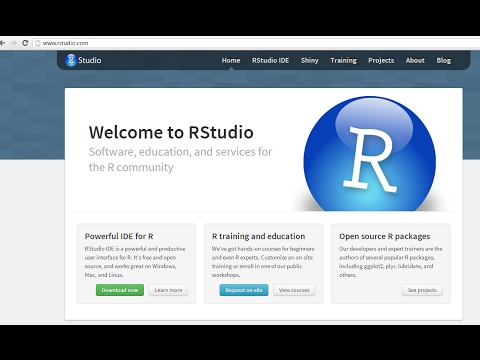
The RStudio desktop version can be found here, https://www.rstudio.com/products/rstudio/#Desktop . There is an open source version and a purchased version that includes various options and support.
The icon above takes you to the various desktop versions, select the Mac OS X version.
Once Downloaded, double click on the RStudio package.
Drag the RStudio icon to the Application Folder
On my machine, I have an older version, you can select ‘Replace’ to only keep the new version.
In Launch Pad, Type in R in finder, you will see both R and RStudio. Select RStudio and the following message is displayed, Select Open to run RStudio
Step3 – Try it out
RStudio is now displayed. You get the option to see a demo which will allow us to see if all is working correctly.
Type the following 2 lines of code in the console and press enter;
X = rnorm(200)
Plot(x)
RStudio is now installed and ready for your analysis.
Resources available
There are many resources and tutorials that can be used to learn more about using the R language, I have listed a few below.
R Project for Statistical Computing, https://www.r-project.org
RStudio, https://www.rstudio.com/resources/training/online-learning/#R
I hope you find these useful.
Steve